The
energy transition places significant demands on growers. The sector must move
toward fossil-free cultivation, but every greenhouse has different energy needs
and each sustainable source comes with its own conditions. A survey shows that
many growers want to take steps — but they lack time, reliable information, and
clarity on costs and policy. Within the RE-Greenhouse project, a new tool is
being developed to help growers more quickly determine which sustainable
options suit their business.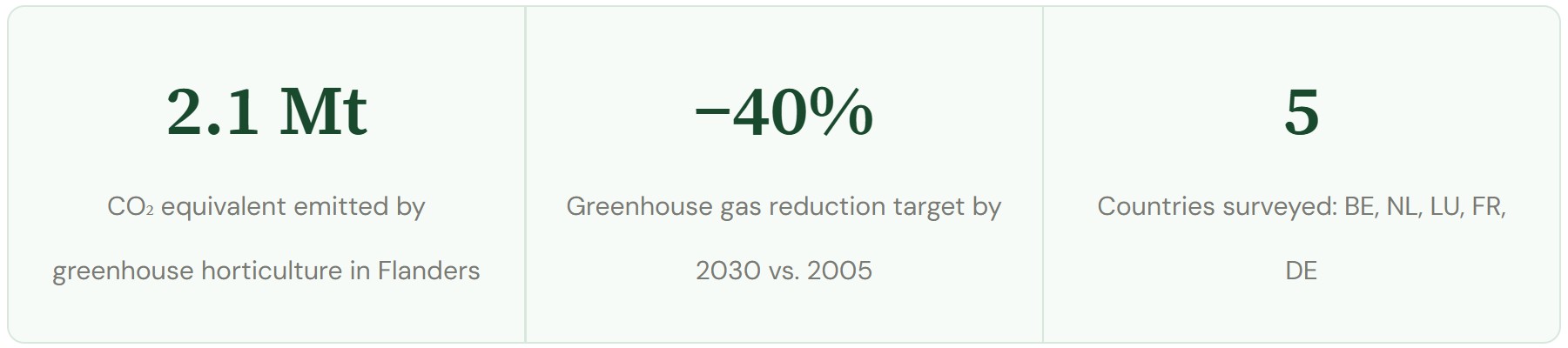
Greenhouse horticulture is one of Europe's most energy-intensive agricultural sectors. Heat, light, and CO₂ are essential for year-round production, and for decades, fossil fuels have been the default answer. But with Europe's 2050 climate targets firmly on the horizon and energy prices remaining structurally high, the pressure to transition to renewable energy has never been greater.
So why aren't more growers making the switch?
Uncertainty and lack of time and knowledge weigh heavily
Within the RE-Greenhouse project, researchers at The Hague University of Applied Sciences surveyed growers and stakeholders across five North-West European countries. The findings reveal a clear picture: the barriers to transition are less about technology than most people assume.
The biggest obstacle is upfront investment costs, combined with uncertain payback periods in a volatile energy market. Close behind are knowledge gaps and lack of time. The energy landscape is becoming increasingly complex, with new technologies, evolving subsidy schemes, and shifting regulations. Growers know the broad strokes of what is available, but struggle to assess what actually works for their specific business.
"Sustainable energy sounds logical, but the investments are large and the payback period remains uncertain. You want to be sure you're making the right choice."
Flemish greenhouse grower
Policy uncertainty adds another layer of difficulty. Subsidies change, conditions vary by region, and growers often cannot determine which schemes apply to their situation without spending significant time on research they simply do not have.
Each energy source has its own pros and cons
Renewable options for greenhouse horticulture have expanded considerably. Geothermal energy, solar power, wind energy, residual heat, biomass, and biogas can all replace a significant share of fossil energy, but each comes with its own requirements and trade-offs.
- Geothermal energy demands suitable underground geology and substantial capital.
- Solar panels perform well in summer but deliver limited output in winter, precisely when greenhouse heating demand peaks.
- Residual heat makes a business dependent on proximity to an external industrial source.
- Biomass and biogas require a reliable fuel supply and adequate storage capacity.
The survey asked growers which renewable energy sources they most urgently need better information on:
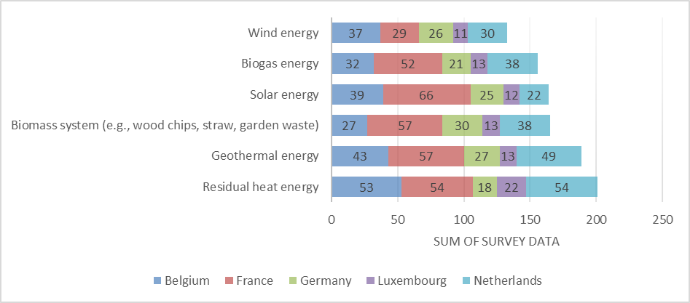
Figure 1 — Residual heat scores highest across all countries surveyed, followed by geothermal energy. These are promising but complex technologies where location-specific, reliable information remains hard to find.
The results show a particular need for more clarity on residual heat — including district heating networks and heat exchange with nearby industry — as well as on geothermal energy.
Lack of knowledge and clarity on costs and policy are greater barriers than technology
The research points to a striking conclusion: the biggest barriers to transition are not technical. Growers are not primarily looking for engineering guidance. Their most urgent need is clarity on policy and regulations.
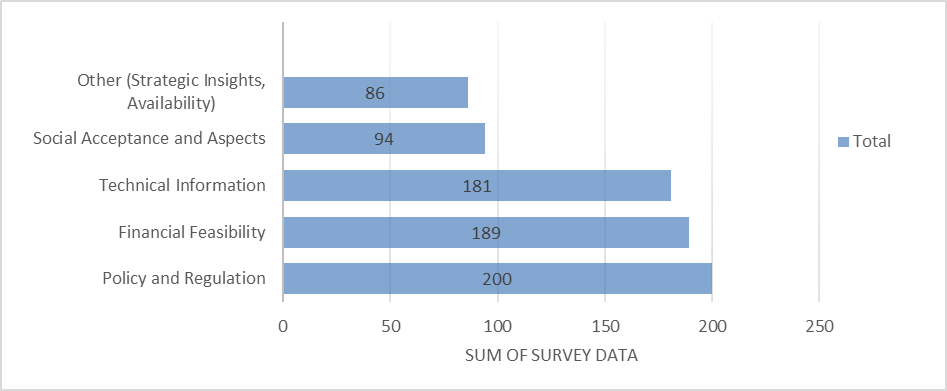
Figure 2 — Policy and regulation ranks first, ahead of financial feasibility. Technical information only comes third. Sustainability in the greenhouse sector is not a technical puzzle — it is above all an organisational and financial one.
"A tool that compares different energy options and takes into account your location and business can really help growers make more targeted decisions."
Maarten Ameye — Researcher at Inagro
A new decision-support tool is on the way
To address this gap, RE-Greenhouse is developing a dedicated decision-support tool for greenhouse growers, expected to launch in the second half of 2026. The tool analyses a grower's specific energy profile , taking into account greenhouse type, location, crop, and current energy use and identifies which renewable energy sources are technically feasible and economically promising for that particular situation.
The tool does not generate ready-made advice. Every greenhouse is different, and no algorithm can replace the expertise of an installer or energy adviser. What it does is cut through the noise: it organises the available options, highlights relevant subsidies, and gives growers a clear starting point for more targeted conversations with experts.
We expect the tool to save a significant amount of time, as growers will no longer need to search through fragmented information themselves. Moreover, it helps compare realistic options by taking into account the specific characteristics of each business, making it easier to make a well-informed decision.
Get guidance and advice
Later this year, RE-Greenhouse will introduce a voucher system enabling growers to receive expert support in exploring their renewable energy options.
Reference: THUAS: Duijvesteijn, L. (2025). Identifying information needs in
greenhouse horticulture for the development of the 'GH RES decision making
tool' (Master's thesis, The Hague University of Applied Sciences).
RE-Greenhouse is co-funded by the Interreg North-West Europe programme through
the European Regional Development Fund.